A Special Pain and Wonder Sneak Preview
of
From Weird and Distant Shores
Coming Summer 2001 from Subterranean Press.
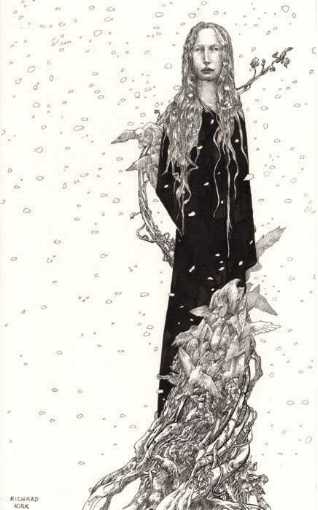
Illustration for "Emptiness Spoke Eloquent" by Richard A. Kirk, Copyright © 2000 (Cover art by Bob Eggleton below)
From Weird and Distant Shores is Caitlín's second full-length short story collection, the follow-up to the critically-acclaimed Tales of Pain and Wonder. This collection gathers stories that she has written for "theme" and "shared-world" anthologies, such as The Sandman: Book of Dreams, Michael Moorcock's Pawn of Chaos, and The Crow: Shattered Lives and Broken Dreams, as well as her early and hard to find science fiction stories, plus a previously-unpublished short story collaboration with Poppy Z. Brite titled "Night Story 1973." Canadian illustrator Richard A. Kirk, whose work was featured in Tales of Pain and Wonder, returns with an illustration for each of the 14 stories in the collection. Award-winning fantasy illustrator Bob Eggleton has supplied a full-color, wrap-around cover. From Weird and Distant Shores will be released simultaneously in numbered and lettered, limited-edition hardback states. Below is an excerpt from "Stoker's Mistress," one of the stories included in the book.
from "Stoker's Mistress"
(Originally published in Dark Destiny III: Children of Dracula, 1996)
Act III
Nuremberg, July 1885Scene 1: Alt-Nunberg, The Five-Cornered Tower (restored)
They have come to Germany and this city, business and holiday in one, precious time away from the Theatre and London, the bright Bavarian air and a chance to take in local colour for the Lyceum's forthcoming production of Goethe's Faust: Henry Irving and Ellen, Bram and a scene painter, a few others.
"It's all perfectly monstrous, really," the actress says and Bram turns to look at her, comes slowly, reluctantly, back to the world from his contemplations, and Henry says, "Well, yes, Ellen, I suppose that was rather the point."
Bram smiles at such a purposefully bad pun and, "I don't mean to sound morbid, but there is a certain elegance to it, so much art turned to the business of torture. Art and science," and he turns back to his examination of the device, Verfluchte Jungfrau, the Iron Maiden of the Tower. Alone at the center of the chamber, dusty and rust-scabbed, crudest parody of a woman's form, subtle lines and curves cast in cold iron. He steps closer, inspecting her hollow, spiked interior laid open for all to see, to witness: each skewer placed just so, to pierce eyes and heart, belly and genitals, when she is closed again. And he remembers the jaws of an odd plant, an exhibition of carnivorous flora and the Venus flytrap brought from America. Something of those green jaws in this thing, something of this thing in the needle jaws of that plant.
"Ghastly," Ellen Terry says. "This whole drafty place is ghastly."
"This is atmosphere, Ellen. Priceless stuff," Irving says, examines the disorderly collection of headsman's swords gathered against one wall. "If we could only capture half the mood and implied violence of this place with our props and paint and tricks of light. Tell her, Bram."
But he doesn't answer, lets his eyes trace the Maiden's outstretched arms, the long and bristling knives set along their length and he looks down, then, to her feet, one a mechanism when touched by the executioner's boot caused the arms to spring closed, and there's another way to die at this woman's touch. Another way she drew blood.
"Prisoners who were to be put inside," he says aloud, thinks aloud without having meant to speak, "Those prisoners first were made to kiss her, their lips to hers," and "Bram, please," Ellen groans, "I think I've had enough of this dreadful place to last three lifetimes."
"Yes," he says, wondering if the old gears and springs have rusted fast, if the Maiden has been disarmed by time and neglect, inexorable corrosion of metal by the damp tower air. Or if she might still kill, if anyone were very foolish or unlucky.
"Bram," and he feels the gloved weight of Henry's hand on his shoulder. "There's still much of the Castle left to see, and I think almost all of it will sit much better with poor Ellen." And he follows them down the winding staircase, dim light and their footfalls, and Henry talking, stories about the castle's past, real and fancied: bottomless wells dug into the native rock by slaves condemned never again to see the light of day, and fearless outlaws, secret passageways and the intrigues of burggraves and knights and saints.
And the Order of the Dragon, let's not forget them, he says as they step out of the tower, into warm courtyard sunlight and air that smells of the city and summer gardens, but Bram only half listens, Yes, another of those murky mediaeval Catholic armies, still seeing the daggers on the Maiden's long arms, the spikes in her empty soul, It's supposed to have held all its most secret meetings and ceremonies somewhere in the Castle.
"Like the Knights Templar?" Ellen asks and that brings him back again, her voice and the smell of summer. He runs one hand across his face, through his beard, tries to push away the images of execution, flesh lips to iron lips, the creaking sound of hinges closing to bring absolute piercing blackness.
"Something like that, I suppose," Henry Irving says.
"Were they out for the holy grail as well?" she asks and Henry laughs, and Bram wants to glance back at the tower, to trace his way up the crumbling wall; "No," he says, instead. "Another defense against heretics and Turks."
"Bloody heathen Turks," Ellen says grimly, voice low and chin held close to her chest, and they all three laugh.Scene 2: Beyond the Westthor Graben
In the carriage that bumps along beside the dark waters of the Pegnitz, a ride alone to try and clear his head. Because he woke in the night from a dream of death in a cold woman's bladed arms, because he's tired of talking Faust, tired of sausages and German hospitality and the steep and red-tiled roofs. Homesick and wants to shake off the uninvited obsession with the dank little museum in the Tower, display of vicious treasures salvaged from the Rathaus prison and the Vehmgerricht, and so he has left them all behind for an afternoon, has told Jacobb, his coachman who speaks English like broken crockery, to drive him into the forest, away from the city. Away from the Castle. "Ja, mein Herr," and soon they were rattling away from Nuremberg and the leaf shadows of the trees and the songs of birds are making him sleepy.
He considers closing his eyes for a time, not sleeping, resting my eyelids, his father would have said, just resting my eyelids, but the thought that he might be visited by the dream again and so he stays awake, watches the river, ducks bobbing there like white and grey feathered boats, until the road turns north and the trees close around them. Yews and oaks, cypresses that have grown here since before the first tower was raised at the Burg, bowed trunks and arthritis branches that would count their lives in centuries as years. And up ahead he notices a much narrower road turning off, feels the welcome goad of curiosity, something he hasn't seen before, something no one has seen in some time, perhaps, and he calls for Jacobb to stop.
Dust cloud and woodcreak, the horses seeming reluctant to stop here and Jacobb seeming offended at his request, but the carriage pulls to a halt, and the coachman leans down, speaks through his thick mustache, "Ja, Herr Stoker?" and Bram points. "Where does that road lead?"
"Ah," and a long pause while he gazes nervously at the neglected path, grass thick between its ruts and "Nowhere, that road leads," he answers, finally.
"Come, man, it leads somewhere, surely?"
"Nah, nowhere," Jacobb says again, insistent, and the horses straining in their reins. "No good place to be stopping for," he says. From where Bram sits, the road seems to drop away through a long, winding hollow. "I want to go down that road, Jacobb, and should very much appreciate knowing why this place is upsetting you."
And far away, filtered through the forest and across miles, an animal's cry or yelp, a dog, or wolf, perhaps, but nothing quite like either. Jacobb, face pale and sweating, struggles to calm the frightened horses, leaps down from the box when Bram climbs out of the carriage to get a better view down the road.
"No good place stopping for," he says again.
"Was that a wolf? Aren't we awfully near the city for there to be wolves in these woods?"
Jacobb is petting the horses, calming them with his big hands and whispers in their ears and he doesn't turn around to answer, "Ja, wolves," he says, and nothing else. Back to his ministrations with the horses, takes the bridles and leads them twenty or thirty feet further along the road. Bram follows, notices something at the crossroads, a stone cross fallen over and broken. Weathered granite and he steps off the road, brushes aside the creepers and tall grass and there is an inscription on its base: Die Toten reisen schnell.
"Jacobb, what is this place? What's in the valley?"
"Worse place than this," he says, still standing with his horses but looking back at Bram now. And Bram bends closer to read again the words cut into the stone, and he sees something else that makes him stop.
"Christ, Jacobb. What is this?"
An iron rod, rust-purple, rising from the shattered monument, iron finger aimed up at Heaven, or down.
"Who killed themselves," Jacobb says, wary, brittle voice, and speaking almost too quietly to be heard. "She who killed themselves and buried her here."
"You're not even making sense now, Jacobb," but he recalls something, then, old superstition and another shunned crossroads outside Andover in Hampshire, years ago. Burying suicides at crossroads, and he touches the protruding end of the iron spike. It is driven firmly into the earth and will not budge.
"We go back now," Jacobb says, firm and as if to prove his point, that cry again, and maybe closer this time, maybe a trick of the woods. Not a dog and not at all how Bram would have thought a wolf would sound. Distance playing tricks, and he steps back from the grave, says to the coachman, "Yes. But first you tell me where that road leads. Then we'll go back to the city."
The horses paw the ground and shake their heads and "It is unholy," the coachman says, and if his voice was brittle before, it is broken now. "That place down there."
"The valley is unholy?"
"A village, a village that was there, long, long..."
"The village, then, the village was unholy? Why?"
"Herr Stoker, please, I answer your question now."
Bram glances back at the impaled grave, the cross tumbled over, busted apart, and for the third time the cry drifts through the woods, lost and searching sound, lonely sound, almost human, and he feels the prick of gooseflesh beneath his clothes. Hesitates a moment longer. "That's not a wolf, is it Jacobb?"
"Unholy," Jacobb says, crosses himself and scrambles back up to his box. "I go back with you or not, now, Herr Stoker."
"Yes, Jacobb, I'm coming," and another plaintive cry as he climbs into the carriage, this one from the opposite side of the road he thinks, so two now, two at least, and he notices how deep the shadows have become, how close to dusk. And it will be night before they're even out of the forest, much less back within the city's walls. The horses rear and Jacobb has to whip them, biting leather swish of his crop in the still air and then they are moving past the crossroads, and Bram steals a last glance down that other way, unholy, and sees or imagines a stirring in the gloom. A hundred yards past the crossroads and the wheels of the carriage jounce and rattle as if they might slip from the axles and Jacobb is still whipping the horses; Bram begins to call out for him to slow the carriage, to ease up on the poor animals and he sees the inscription again, The Dead Travel Fast, epitaph or warning or augury, and he doesn't say a word.
And night comes, faster even than he'd feared. Black enough for night; maybe a last few rays of straggling daylight left above these trees but black enough below.
"Hurry," he calls out to the coachman, but knows that Jacobb hasn't heard him over the furious clop of hooves, the carriage racket. But he does become aware of another sound, a panting and the slap of softer feet on the road and he looks, fearful, and can make of the dimmest form running along beside the carriage. Never a wolf half that large. Eyes that burn the same hot orange as stoked coals or steel under the blacksmith's hammer, eyes that turn and look back at him, eyes that smile when they know he sees. He clutches his walking cane as if it might protect against eyes like that, makes the sign of the cross although it is not of his faith.
"There is something on the road," he calls out and is surprised when Jacobb answers, "Ja, Ja, something..."
And the road is rising ahead, darker place where the trees seem to twine together, braid of ancient boles, and the carriage begins to slow; Jacobb whips the frantic horses and he's cursing in German, calling the names and mercy of Saints and Bram hears the horses begin to scream, a sound almost as unnerving as the strange cries floating across the valley. And the thing with burning eyes slams into the coach, patch of utter darkness and those two fires where its head must be and it rams the carriage like an angry bull. The coach rocks up onto its two left wheels, almost capsizes, spilling Bram and the coachman into the road, bounces back down and springs groan and wood splinters loud.
And now there are other eyes in the night.
A smell like shit and death long under summer sun and its forepaws on the passenger steps, titling the carriage its way, and Bram can see that smile now: black lips curling back and the teeth, grandmother, what big teeth you have, what white teeth. Raises his walking stick, fine oak but it may as well be a match stick and then he hears the woman's voice, Latin spoken sloppy fast in commanding tones and the Irish brogue coming through and Jacobb smacks the thing across the snout with his riding crop. It turns its head, its grinning jaws, away from Bram, but not toward the coachman, as if it hadn't noticed the blow, and the woman is shouting. Not one word can he make out and her voice so loud it hurts his ears.
The beast moves slowly away from the carriage, reluctant lion or tiger forced back by the trainer's lash, and a sound from far down in its throat, a hateful, cheated, hurting sound like a promise. Stands a moment longer on the road, facing the direction of the woman's voice, and other voices rise from the forest around them, other threats, and it backs away, one last glance towards Bram, those eyes, twin doors to Hell left open for his edification, and then is it gone. And the other eyes peering through the trees are gone, and the horses are racing forward.
As they pass, Bram catches the briefest glimpse of the woman, her skin like alabaster reflecting light that isn't there, hair black as the thing she has driven away, and he knows that face.Copyright © 1996 by Caitlín R. Kiernan. Used by permission.
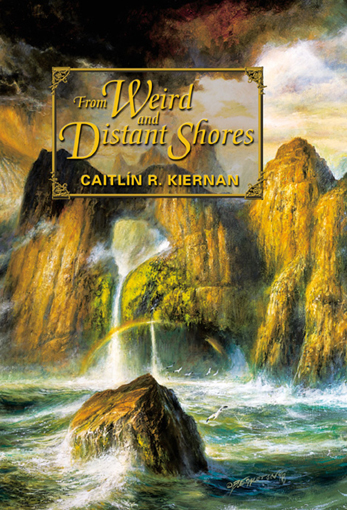
Cover art (click to see full wrap-around cover) : Land of the Gods (1998) by Bob Eggleton
Copyright © by Bob Eggleton
Table of Contents
From Weird and Distant Shores will include the following stories:
"Persephone" (1995)
"Between the Flatirons and the Deep, Green Sea" (1995)
"Hoar Isis" (1995)
"The Comedy of St. Jehanne d'Arc" (1995)
"Escape Artist" (1996)
"Stoker's Mistress" (1996)
"Giants in the Earth" (1996)
"Emptiness Spoke Eloquent" (1997)
"Two Worlds, and In Between" (1997)
"Found Angels" (with Christa Faust, 1998)
"The King of Birds" (1998)
"By Turns" (2000)
"Night Story 1973" (2000, with Poppy Z. Brite, previously unpublished)
"Rat's Star"(1997, previously unpublished, only included in numbered state)
Caitlín talks about From Weird and Distant Shores
P&W: So, what makes From Weird and Distant Shores different from Tales of Pain and Wonder? Are they different sorts of short story collections?
CRK: Yes, I think that they're very different sorts of collections. With ToPaW I was given the opportunity, finally, to compile a large number of interconnected stories, a more or less coherent story cycle that I'd been working on for years. Sometimes I feel as though ToPaW ought to be thought of as my second novel, instead of Trilobite, because it does have a fairly obvious narrative, and a beginning, and something of an ending, even though most of those stories appeared independently in a lot of different anthologies. I suppose that FWaDS is more of a traditional collection, in that sense. It really is a compilation of short stories and not the odd sort of almost novel that ToPaW turned out to be.
P&W: But there is something that most of the stories in FWaDS have in common with one another, isn't there?
CRK: Well, yes and no. When Barry Hoffman at Gauntlet Publishing asked if he could do a collection of my short fiction and I put together ToPaW for him, I was left with eleven or twelve stories that weren't part of the cycle. They were a mixed lot - my early science fiction, and stories that I'd done for various "theme" and "shared-world" books since 1994. Most of them are stories that were set in other people's fictional universes, because when I was getting started in the mid-nineties, I don't know, it was sort of the Golden Age of Theme Anthologies, I think. I was constantly being offered the chance to write for books set in other authors' worlds. It was the marketing ploy of the day and almost everyone was writing for these books. The stories in ToPaW are mostly stories I found time for when I wasn't writing a Sandman story or a Crow story or something inspired by a role-playing game.
P&W: Explain what you mean by "theme" anthology.
CRK: Theme and shared-world anthologies. They're pretty ubiquitous, actually. All you have to do is go to a bookstore and look in the sf or fantasy or horror section and they're all over the place. Shared-world anthologies are books where writers have set stories in worlds created by someone else. Theme anthologies are books where all the authors are being asked to write stories clustered around a single, central concept. They both rely on a built-in audience. Shared-world books are generally working on the franchise or brand-name model, counting on everyone who bought Big Hit X to buy this book, too, because all the stories in it are related directly to Big Hit X. They're books based on movies or television shows, comic books and role-playing games, or even on other people's novels or short story collections. Sometimes they're referred to as media tie-ins, as though literature wasn't a medium. Anyway, then you have theme anthologies, hoping to find a particular audience with a neat, little package designed to appeal to some particular demographic group. And sometimes the two get mixed together, so you get something like, say, a Star Trek anthology about gay war veterans. It can and does get pretty bizarre.
P&W: Was that very frustrating or limiting, working so much of the time on stories for those sorts of books? Do you think the proliferation of theme anthologies has been bad for science fiction and fantasy?
CRK: I wrote a preface about this for FWaDS, trying to answer this question, so I'm not going to get too far up on the soap box again right now. It's a complicated question, and I always wind up answering it yes and no. On the one hand, it's obvious that this is definitely not the way to produce good fiction, that it's usually pandering, and it's very easy for writers to find themselves consumed by these sorts of projects to the extent that they don't have time for their own work. Such books often pay very well and, although I know that readers like to pretend that writers are above eating and worrying about rent and hospital bills and such, that we're all doing it for Art every time we put pen to paper, or fingertip to keyboard, whatever, that's a very naive view of the lives of most writers, especially those of us who get pegged as genre writers. But, on the other hand, I've never gone into one of these projects as though it were less important than my original work. I made it a rule, from the very beginning, to treat every story I write as though it were as important as every other, to always write the best I can and never just sort of sit back and coast along on auto-pilot because this or that piece was only intended for a shared-world book. And some of my personal favorites have come from these sorts of books, stories that I think will always mean a lot to me.
P&W: How was doing The Dreaming for DC Comics, where you're writing characters created by other people, mostly Neil Gaiman, different from these sorts of anthologies?
CRK: It's no different at all. Which has made it very hard and very frustrating and sometimes very depressing. The Dreaming has taken an enormous amount of my time the last four and a half years, to the extent that I almost couldn't finish Trilobite, my second novel. But I'm immensely proud of some of the stories I've told in The Dreaming and I worked very hard to take the title in a different direction than The Sandman, to take it to the places my prose fiction goes, which I know hasn't sat very well with a significant number of The Sandman readers. But, that's where this sort of thing becomes pandering, when you worry more about keeping readers happy, giving them what they want, than you do about being honest to the things you need to say. I also think there's a fundamental difference between sequential fiction, like comics, and short stories or novels. Neil created an incredibly beautiful and original thing with The Sandman, but he began with someone else's characters. Actually, a lot of different someone elses. He created The Endless, except for Destiny, but most of the supporting cast of the series dates back to at least the seventies, and some back to the thirties. That's something that the people who've complained so much about The Dreaming being nothing more than an attempt to capitalize on the success of The Sandman either seem ignorant of or it's a fact they've simply chosen to ignore because it's inconvenient to their argument. I'm getting way the hell off the subject, aren't I?
P&W: You've said elsewhere that some of the stories in FWaDS are being published in their original form for the first time.
CRK: That's not what I said, exactly. But some of these stories did get banged up a bit by zealous copy editors in their original publications. The best example is "The King of Birds," which first appeared in The Crow: Shattered Lives and Broken Dreams. When that book came out and I first saw it I was, I don't know, speechless. The text had been altered to such a degree that it wasn't even really my story anymore. Some copy editor at Del Rey had actually rewritten it. I was furious and made sure that the text was corrected for the trade paperback That sort of thing has happened before, but I've always managed to catch it when the publisher sent me galleys. When I got the galley pages on "The King of Birds," a few things had been changed and I changed them back again. The rewriting happened sometime after I returned the galleys and I had no idea it had occurred until the book was in stores. I think I asked the editor at Del Rey why the hell they hadn't included the copy editor's name as coauthor. I was really way beyond unhappy.
P&W: This collection is coming right on the heels of ToPaW. Do you think it's unusual to have two short story collections released so close together?
CRK: I don't know if it's unusual. I think it's just a consequence of the fact that I'd rather write short stories than novels, so I've written an awful lot of them, something like forty in the last eight years. And they pile up. Collections are good places to keep them so they don't go wandering off causing trouble.
P&W: And there's a story by you and Poppy Z. Brite in FWaDS. Is this the first time you've written together?
CRK: Yes, it is. The publishers wanted an original story for FWaDS and, years ago, Poppy and I had talked about collaborating on a story set in her fictional town of Missing Mile, North Carolina. That fit with the scope of this book, so I called her and suggested we do it now and she said sure. So we wrote a story called "The Rest of the Wrong Thing," but when I was done with the first draft, well, it was really much longer than I'd intended, and we decided to give it to another publisher to put out as a chapbook. So we did a second collaboration, called "Night Story 1973," about her character Ghost from Lost Souls when he was a little boy. That's the one that's in FWaDS.
Copyright © 2000 by Constance Lynn. Used by permission.
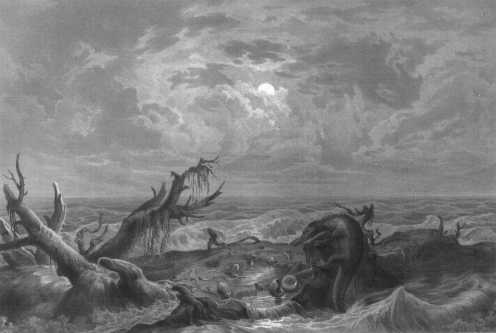
"The Period of the Muschekalk [Middle Trias]" from Primitive World by Franz Unger (1851),
originally planned as cover art for From Weird and Distant Shores